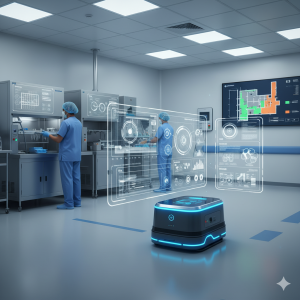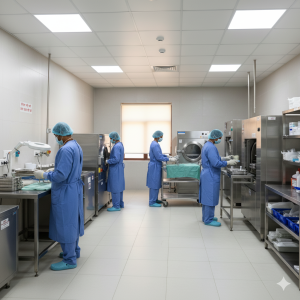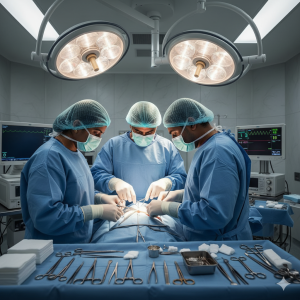
Deep within the operational core of every successful hospital is its Central Sterile Services Department (CSSD), also known as the Sterile Processing Department. Far from being a simple service unit, the CSSD is the hospital’s first line of defense against infection, the critical hub that enables safe and effective patient care.
Yet, this vital department is often misunderstood. Misconceptions can lead to operational inefficiencies, undervalued teams, and, most critically, compromised patient safety.
It’s time to set the record straight. Here are five common myths about sterile processing—debunked.
Myth 1: If it went through the autoclave, it must be sterile.
The Reality: Sterilization is a multi-step process, and it begins with meticulous cleaning.
An autoclave is incredibly effective, but steam and sterilants cannot penetrate bioburden—the microscopic layer of blood, tissue, and fats left on an instrument after a procedure. If an instrument is not thoroughly cleaned before it enters the sterilizer, this bioburden can act as a shield, protecting the microorganisms underneath. The CDC explicitly states that cleaning is the essential first step in any sterilization process, as inorganic and organic materials that remain on instrument surfaces interfere with the effectiveness of these procedures.¹
Effective sterile processing starts with manual and automated decontamination, using the correct enzymatic cleaners and techniques to remove all visible and non-visible soil.
Myth 2: Our sterilizers are automated, so human error is eliminated.
The Reality: Technology is a powerful tool, but it relies on human expertise to function correctly.
Modern sterilizers are technological marvels, but they are not infallible. Their effectiveness depends entirely on the skilled professionals who operate them. Key human-led factors include:
- Proper Loading: Instruments must be loaded correctly to ensure steam can penetrate all surfaces. Overloading or incorrect placement can create air pockets and cold spots where sterilization fails.
- Routine Validation: CSSD technicians are responsible for running daily validation tests using Biological and Chemical Indicators. These routine practices are the primary method for monitoring sterilizer efficacy and ensuring patient safety.
- Maintenance & Record-Keeping: Diligent monitoring and maintenance, guided by the expertise of the CSSD team, ensure the equipment performs to specification every single cycle.
Myth 3: CSSD is just the “hospital basement”—a glorified dishwashing area.
The Reality: CSSD professionals are highly skilled technicians who are essential to patient safety.
This is perhaps the most damaging myth of all. A CSSD technician requires a deep understanding of microbiology, chemistry, infection control, and complex medical instrumentation. They are the specialists who can identify thousands of different surgical instruments, understand how each one must be disassembled and reassembled, and operate sophisticated decontamination and sterilization equipment.
By preventing Surgical Site Infections (SSIs), the CSSD team directly impacts patient outcomes, reduces hospital readmission rates, and saves lives. Global health guidelines emphasize that the proper reprocessing of surgical instruments is a cornerstone of SSI prevention.²
They are not dishwashers; they are the guardians of sterility and a critical component of any hospital’s infection prevention and control program.
Myth 4: Buying cheaper instruments saves the hospital money.
The Reality: Low-quality instruments have a higher Total Cost of Ownership (TCO) and can increase risk.
From a purely financial perspective, the upfront saving on a cheaper instrument is often lost many times over during its lifecycle. Lower-quality steel and poor craftsmanship, as we discussed in our post on German Stainless Steel, lead to numerous downstream costs for the CSSD and the hospital:
- Difficult Cleaning: Poorly finished surfaces with microscopic pits, crevices, and burrs can harbor bioburden and are significantly harder to clean effectively.³
- Frequent Damage: Cheaper instruments are more prone to staining, pitting, and breaking, leading to higher repair and replacement costs.
- Risk to Patients: A malfunctioning or contaminated instrument represents a significant risk to patient safety and a massive liability for the hospital.
A high-quality instrument is an investment that pays dividends in efficiency, reliability, and safety.
Myth 5: The CSSD’s scope is limited to the Operating Room.
The Reality: The CSSD is a central service hub for the entire healthcare facility.
While the Operating Room is a primary “customer,” the CSSD’s responsibilities extend across the entire hospital. They manage and reprocess reusable medical devices from numerous departments, including the Emergency Department, Labour and Delivery, endoscopy suites, intensive care units, and outpatient clinics.
Their work is integral to the safe functioning of nearly every patient-facing department, making them a cornerstone of the hospital’s entire operational and safety infrastructure.
By dispelling these myths, hospital administrators and clinical staff can better appreciate the scientific rigor and critical importance of the CSSD. Supporting this department is a direct investment in the quality and safety of patient care across the board.